Everyone wants an AI Copilot. But if you’re waiting on one tool to do everything, you might be waiting a while. Leaders across HR, IT, Finance, and Operations are being asked to “do more with AI”, but how?
The default playbook often centers around a single enterprise agent: a Copilot, Assistant, or Chatbot designed to answer employee questions, automate tasks, and connect to systems across the company.
It sounds elegant. But it’s incomplete.
The truth is, building one general-purpose AI to serve every function – HR, Legal, IT, Marketing, Finance – isn’t just hard. It’s the wrong choice. It delays deployment, ROI, and success. One of the hidden costs of an enterprise-agent-only strategy is waiting. HR or Finance might be ready to automate today—but end up stuck behind IT in the Copilot queue.
Generalized Agents Have Limits
Ask your generalized AI to explain your vacation policy? Easy.
Ask it to initiate a leave request in Workday, adjust for California compliance, and notify payroll? That’s where things get tricky.
General-purpose agents struggle when real execution is involved. That’s because:
- They lack deep domain logic
- They aren’t integrated with function-specific systems
- They pose governance and compliance risks in sensitive areas like HR or Legal
- And they often delay innovation—HR might be ready to move, but stuck behind IT in the backlog
Specialized Agents Solve for Depth, Speed, and Risk
There’s a better model emerging, one inspired by how businesses actually work.
Think of your enterprise AI like a conductor. It’s great at triaging questions and orchestrating requests. But when it comes time to execute, it needs specialists.
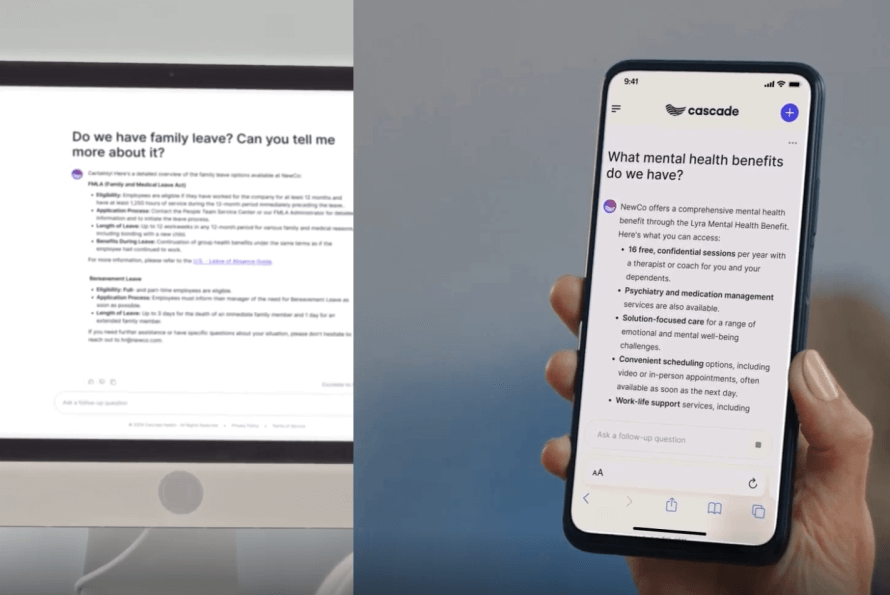
Specialized agents—like Cascade AI for HR—are purpose-built for their domain. They come embedded with:
- Real-time integrations (e.g. Workday, ADP)
- Policy-aware logic that adapts by role, location, or scenario
- Workflow automation, not just Q&A
- Audit trails and decision logging for compliance
And they’re designed to plug into your broader AI ecosystem, not replace it.
One Interface. Many Experts.
This isn’t about fragmenting the user experience. It’s about enhancing it.
Protocols like Anthropic’s Model Context Protocol (MCP) and Google’s Agent-to-Agent (A2A) enable seamless delegation: one assistant on the surface, multiple agents under the hood.
Employees still talk to “Copilot.” But when the task involves HR, the request is routed to Cascade. The experience is unified. The execution is domain deep.
Why Start with HR?
HR is often the readiest for AI, but the least prioritized. We’ve seen firsthand how fast HR teams can move when they’re not waiting on centralized AI builds.
It’s also an ideal place to pilot this new model because it offers opportunities to start with high-impact, limited-scope use cases that show immediate value. These include:
- M&A employee transitions
- Manager enablement support
- Open enrollment decision support
- Offboarding
In addition to targeted use cases like these, HR stands out for:
- High ticket volume
- Clear compliance needs
- Well-defined systems
- Immediate employee experience impact
Cascade customers go live in under 30 days. We handle up to 96% of HR tickets, guide onboarding, automate leave, and more.
The enterprise agent doesn’t have to do it all. It just has to know who can.
Let’s Rethink What Enterprise AI Looks Like
Enterprise AI isn’t one monolithic assistant. It’s a team. The fastest path to value is modular, not monolithic.
Specialized agents aren’t just feature-rich, they’re function-ready. And they help AI leaders avoid the trap of waiting months (or years) to see ROI.
Your AI strategy should be a team sport. Cascade is ready to play.
Curious how specialized AI can unlock value faster? Request more info or book a demo here