Legacy HR software providers are talking about their AI advancements, but without an intelligence layer, AI in HR remains fragmented, siloed, and shallow.
HR leaders don’t need more AI features. They need a single intelligence layer that unifies them.
Every HR tool now claims to be “AI-powered.” Chatbots, copilots, and assistants appear in every product update. For CHROs, that should sound like progress. Instead, it often feels like noise.
Employees jump between tools for payroll, benefits, performance, and IT requests. Each tool has its own assistant that can answer a few questions, but none of them share knowledge or context. One bot resets a password. Another approves a leave request. A third pulls a report. What’s missing is a shared understanding of the employee or any coordination across tools.
What’s emerging isn’t transformation. It’s a fragmentation with a new interface.
The Real Problem: No Intelligence Layer
The issue isn’t that HR lacks AI. It’s that AI in HR lacks connection.
HR data, workflows, and communications live in silos. Automations work within tools, not across them. An intelligence layer changes that — it connects systems and orchestrates workflows so every interaction becomes smarter and more contextual.
Without it, HR ends up with disconnected tools, manual data flow, and inconsistent personalization. Each system knows a little about an employee, but no system knows the whole story. The result is surface-level AI that automates tasks without improving decisions or the employee experience in any lasting way.
The Shift: From Tools to an Intelligent HR Ecosystem
The next phase of AI in HR isn’t about adding more copilots. It’s about connecting what already exists.
An intelligence layer enables that shift. It:
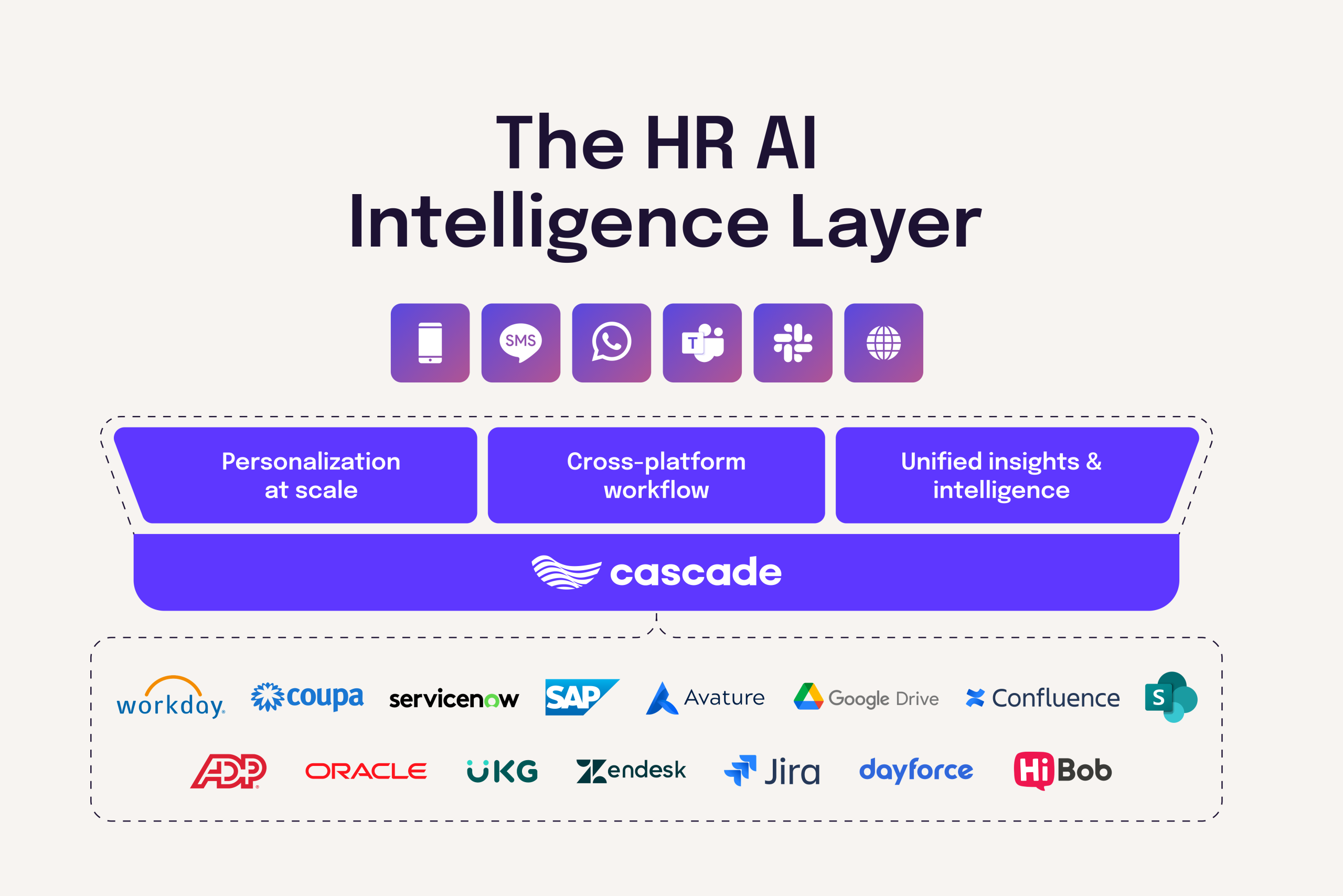
- Integrates across HR tools like Workday, ServiceNow, SAP, and others
- Powers unified workflows across Slack, Teams, and other communication channels
- Delivers shared insights that drive personalization and better decisions
Underneath those outcomes are four design principles that make true AI-first operations possible. The intelligence layer only works when it:
- Connects across domains — linking HR, Benefits, and enterprise systems into seamless, end-to-end workflows
- Understands HR deeply — encoding the policies, language, and compliance frameworks that define the function
- Adapts to real users — delivering intuitive, context-aware interfaces embedded where employees already work
- Keeps HR in control — enforcing governance led by the function, ensuring privacy, compliance, and trust by design
When these principles come together, HR stops managing disconnected tools and starts orchestrating outcomes.
How we designed Cascade around this idea
At Cascade, this belief shaped our product from the start. We built Cascade AI as the intelligence layer for HR. It connects systems, unifies workflows, and turns everyday data into actionable insight.
The goal isn’t to replace your HR tools. It’s to make them work together intelligently, securely, and at scale.
That’s what makes AI-first operations possible, and why every HR organization needs an intelligence layer at the center of its ecosystem.