How enterprise IT and HR leaders can build safeguards into AI agents while the governance rulebook catches up.
In one of Cascade’s first large enterprise deployments, we prepared for the governance review the way any serious enterprise AI company should. The customer was deploying AI into employee support workflows, where the system would handle sensitive HR questions, policy interpretation, and operational requests across systems of record. The review mattered.
Then we discovered their AI review process itself did not yet exist.
Our customer had mature security expectations. It had procurement requirements, privacy requirements, access-control requirements, and a clear internal instinct that AI needed governance. What it did not yet have was a governance path designed for agentic systems: software that can reason over documentation, invoke workflows, route sensitive topics, generate records, and hand work back to humans when policy or judgment requires it.
That early deployment clarified the problem we still see across the market. Enterprises are not asking whether AI governance matters. They know it does. The harder question is where governance should live and who should own it.
Our answer is simple: governance cannot be a document attached after the model ships. It has to be defined at every layer of the stack.
For AI agents in HR and IT, governance is not a review gate, a procurement artifact, or a legal appendix. It is the operating model of the system itself: the models selected, the data boundaries enforced, the rules encoded, the workflows designed, the logs preserved, the sensitive topics flagged, and the human decisions protected.
Put differently, governance is how an enterprise decides what the system is for, where its authority ends, and when a human being must re-enter the loop.
The Standard Enterprise Review Is Necessary, But Not Sufficient
Traditional enterprise software reviews were designed for deterministic systems. They ask sensible questions: is data encrypted, is access least-privilege, are logs retained, are vendors reviewed, are incidents escalated, are controls operating over time?
Those questions still matter. In fact, they matter more for AI systems. A serious enterprise AI platform should be able to show the same fundamentals expected of any system handling sensitive company and employee data.
That includes SOC 2 Type II certification across all five Trust Services Criteria: Security, Availability, Processing Integrity, Confidentiality, and Privacy. It also includes AI-specific governance, such as ISO/IEC 42001, the AI management system standard for establishing, maintaining, and continually improving how an organization governs AI systems.
These certifications do not, by themselves, make an AI system safe. But they do establish an important baseline: controls are documented, tested, audited, and operated over time. For CIOs, CISOs, HR leaders, and legal teams, that baseline matters because AI agents are not side tools. They become part of the enterprise’s operating surface.
The gap is that certifications alone do not answer the full agentic question:
What exactly is the agent allowed to do, on whose behalf, with which data, under which rules, and with what human accountability?
That is where AI governance has to become technical.
Human Control Comes From Guardrails
There is a tendency to talk about AI control in abstract terms: alignment, responsibility, oversight, trust. Those words matter, but in production systems they have to resolve into concrete mechanisms.
For HR and IT workflows, human control comes from rules and guardrails.
An agent should not be treated as a general-purpose assistant that happens to sit inside an enterprise. It should be treated as a constrained actor inside a governed system. The system should define what the agent can retrieve, what tools it can call, what actions it can take, what it must cite, when it must ask for clarification, when it must refuse, and when it must escalate to a person.
That distinction is especially important in HR and IT because the organization remains responsible for the outcome. If an employee receives the wrong leave guidance, if an access request is approved outside policy, if a harassment concern is mishandled, or if a legal matter is routed incorrectly, the enterprise cannot say “the AI did it.” The accountable system is still the organization.
Guardrails, then, are not a layer of reassurance. They are the control system.
At Cascade, guardrails operate at the workflow level, not just the prompt level. That means an organization can define how the agent should behave in a benefits question, an IT access workflow, a policy interpretation, a manager escalation, or a sensitive HR matter. The guardrail is not merely “be careful.” It is a specific rule about data, action, escalation, or response behavior.
The best agent systems are therefore not autonomous in the vague sense. They are governed autonomy: fast and useful inside boundaries, conservative at the edge of those boundaries, and explicit when human judgment is required.
Sensitive Topics Require Specialized Workflows
One of the most important governance problems in HR is not whether the agent can answer a question. It is whether the system can recognize what kind of question it is being asked.
High-risk environments need sensitive-topic identification as a first-class capability.
An employee asking about commuter benefits is not creating the same risk profile as an employee disclosing harassment, a mental health accommodation, a legal concern, a medical diagnosis, workplace safety issue, immigration matter, or financial hardship. Those interactions should not all flow through the same operational path.
In Cascade, HR teams can define sensitive topics and configure what should happen when they appear. A harassment matter may need to be routed to a specific HR process. A legal matter may need a different escalation path. A benefits question involving a diagnosis may need to remain confidential unless the employee explicitly chooses to escalate it. A policy question may be answerable immediately, but only from approved documentation and only within the employee’s eligibility context.
This is where AI governance can become more precise than the human status quo. In many organizations, the current routing layer is a shared inbox. The employee writes something vulnerable, the message lands wherever the inbox rules send it, and the organization relies on people to classify, forward, redact, remember, and document the issue correctly.
A governed AI system can do better. It can identify the category of the issue, apply the appropriate workflow, protect the employee’s privacy, preserve the audit trail, and make the escalation boundary explicit.
That is not just risk reduction. It is a better human experience.
Confidentiality and Trust Drives Adoption
The most sensitive employee questions are often the questions people are least willing to ask.
Employees may need help understanding leave after a diagnosis, benefits after a family crisis, accommodations, fertility coverage, mental health resources, compensation policy, immigration constraints, or what to do after experiencing harassment. Those questions are operational, but they are also personal. The employee is not just looking for an answer. They are deciding whether the workplace is safe enough to ask.
This is one of the places where AI can either erode the human experience at work or protect it.
If employees believe every vulnerable question is immediately visible to HR, adoption suffers. People avoid the system, ask colleagues informally, delay important decisions, or never ask at all. If employees believe the system is confidential by design, usage changes. They can ask the first question safely. They can understand their options. They can decide what to disclose and when to involve a human.
Confidentiality is therefore not only a privacy requirement. It is a product requirement and a trust requirement.
The goal is not to remove humans from HR. It is to preserve the moments where human involvement matters most, while giving employees a safe place to orient themselves before they escalate. A well-designed agent should protect the employee’s agency: answer what can be answered, explain what cannot, and make the handoff to a person intentional rather than accidental.
This is why governance and user experience are not opposing forces. In employee support, trust is the user experience.
Governance Has to Operate at Every Layer of the Stack
AI alignment is often discussed as if it lives only inside the model. Model alignment matters enormously, and enterprises should care about the posture of the frontier labs whose models they rely on. But production governance cannot stop there.
For enterprise agents, alignment has to be practiced at every layer of the stack.
It starts with model selection: using models from frontier labs where alignment, abuse prevention, evaluation, and safety research are core priorities. It continues through the infrastructure layer: encryption, isolation, identity, telemetry, audit logs, incident response, and evidence that controls are operating. It extends into the application layer: retrieval boundaries, role-based access, data classification, grounded responses, tool permissions, and workflow-specific constraints. It becomes operational in guardrails, human-in-the-loop controls, sensitive-topic workflows, and escalation policies.
The architecture should make one principle visible:
AI security governance is not the afterthought. It is the model.
AI Governance Stack
Governance is designed into each layer, from the model foundation to the employee experience.
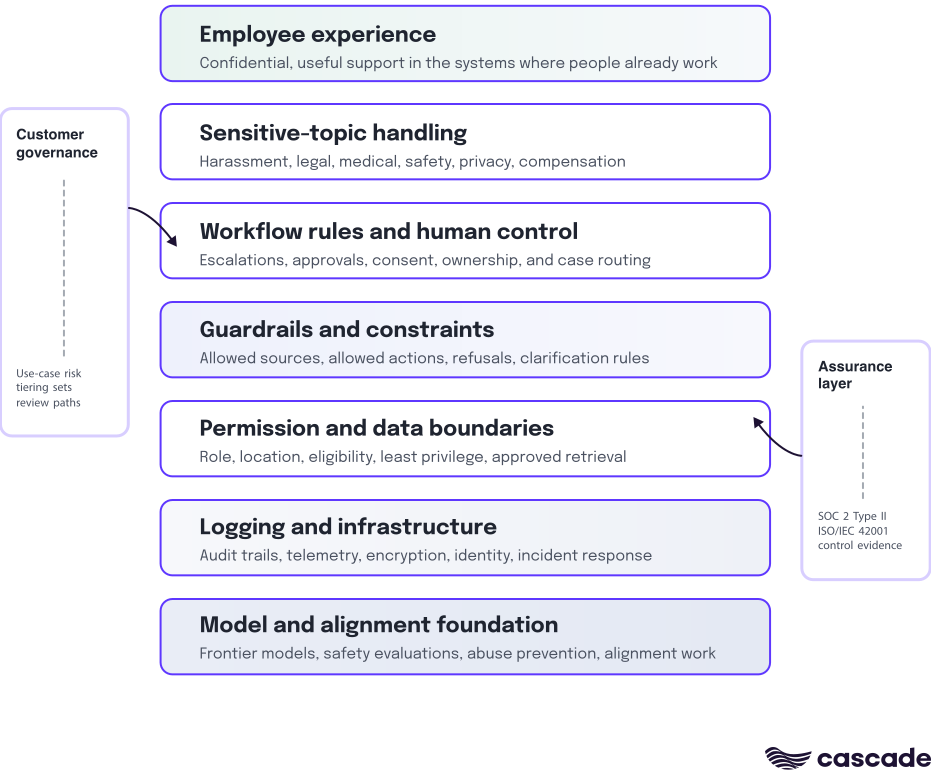
The stack is intentionally read top to bottom by users, and bottom to top by builders. The employee experience sits at the top because that is where trust is either created or lost. The model foundation sits at the bottom because it constrains what the rest of the system can safely do.
SOC 2 Type II across the Trust Services Criteria and ISO/IEC 42001 sit underneath this stack as operating discipline. They do not replace product-level governance, but they help prove that the underlying controls are defined, tested, and continually improved.
This layered view matters because no single control is sufficient. A safer model does not replace logging. Logging does not replace permissioning. Permissioning does not replace workflow design. Workflow design does not replace human judgment. The system is governed because the layers reinforce each other.
That is also how AI systems improve. Every interaction creates evidence: what the employee asked, what the agent retrieved, what rule applied, what answer was given, what was escalated, and where the workflow needed refinement. Governance becomes continuous rather than episodic.
Match Governance to the Risk of the Use Case
The technical architecture is only one side of the governance model. The enterprise also needs a practical framework for deciding which AI use cases can move quickly, which require review, and which should not be built internally at all.
Our recommendation at Cascade is to tier use cases by perceived risk:
| Use-case tier | Examples | Governance path | Decision rights |
|---|---|---|---|
| Low risk | Summarizing public documentation, drafting internal FAQs, organizing non-sensitive notes, automating a personal workflow inside approved tools. | Move with very little friction. Employees should be free to build and ship inside clear boundaries. | Individual or team owner. No formal committee required. |
| Medium risk | Department workflows, internal knowledge agents, repeatable processes that affect employees or customers but do not make consequential decisions. | Coordinate with the accountable team. Confirm data sources, permissions, review expectations, and support model. | Business owner with IT or operations review. |
| Higher risk | Employee data, customer data, systems of record, access permissions, regulated information, compensation, performance, legal matters, benefits, leave, health information, or any workflow where the organization is responsible for the outcome. | Formal review before deployment. Define workflow ownership, escalation paths, audit requirements, sensitive-topic handling, and human accountability. | Business owner, IT, security, legal, HR, and any operational team accountable for the workflow. |
The review should answer two questions. First, is this use case appropriate for an agent at all? Second, if it is, should the organization build it or buy it?
The build-versus-buy decision has changed quickly. In our experience, roughly 70 percent of enterprise operational AI use cases now point toward buying rather than building, especially when the workflow requires integrations, permissions, auditability, adoption, support, and ongoing maintenance. Even some of the most technical customers who begin by building eventually pause or abandon those efforts because the prototype works but the product does not get adopted. The hard part is rarely the first demo. It is making the system useful, trusted, governed, and continuously maintained in the flow of work.
This is why the governance framework should not be treated as an innovation tax. Done well, it accelerates the right work. Low-risk experimentation stays fast. Higher-risk workflows get the review and operating model they deserve. Build decisions are reserved for genuinely differentiating capabilities, while operational infrastructure can be bought from platforms already designed for enterprise governance.
Adoption is Part of Governance. Make the Secure Path the Easy Path.
Enterprise security often fails when it becomes a tax on adoption. Employees route around tools that slow them down, feel unsafe, or require them to learn a new operating model for every request.
AI agents create an opportunity for a both-and design: enterprise-grade governance and a better experience for the people using the system.
For Cascade, that means meeting employees in the surfaces they already use while preserving the security posture IT expects: identity-first access, scoped answers, approved sources, auditable actions, sensitive-topic workflows, and escalation paths that HR and IT can configure. The employee experience should feel simple. The underlying system should be rigorous.
That combination matters because adoption is part of governance. A perfectly controlled system that employees avoid does not reduce risk. It pushes sensitive questions back into informal channels, local workarounds, and unmanaged inboxes. A governed system that people actually use gives the enterprise more visibility, more consistency, and more opportunities to support employees well.
This is the standard enterprise AI should meet: consumer-grade ease at the edge, enterprise-grade control underneath. Robust security should not compromise the user experience; it should make the experience safer, more reliable, and more worthy of trust.
Design for Where Governance is Going
The governance ecosystem for AI agents will continue to mature. Standards will become more specific, procurement reviews will become more sophisticated, auditors will ask better questions, and customers will expect more precise evidence about how AI systems behave in production.
But enterprises cannot wait for every review template to be rewritten before deploying AI safely. The work now is to build systems whose architecture already reflects where the standards are going: traceability, accountability, human oversight, privacy, risk management, and continuous improvement.
That work also requires an internal decision framework. Companies should decide which use cases employees can pursue freely, which use cases need management review, and which workflows are too sensitive or operationally complex to improvise. Without that framework, every AI idea becomes either over-governed or under-governed. Neither scales.
That is the lesson from our first large deployment. The absence of a finished governance review did not mean governance was optional. It meant governance had to be made visible in the system itself.
For AI agents in HR and IT, the bar is high because the work is consequential. These systems answer vulnerable employee questions, touch sensitive data, route operational requests, and shape whether people trust the workplace enough to ask for help.
That responsibility should make builders more rigorous, not slower.
Governance is not what happens after the model. Governance is how the model becomes usable in the enterprise.
At Cascade, this is the standard we are building toward: governed AI agents for HR and IT service delivery, live in as little as 2-4 weeks, with SOC 2 Type II certification across all five Trust Services Criteria, ISO/IEC 42001 certification for AI governance, workflow-level guardrails, sensitive-topic routing, and full auditability across agent actions.